

How Much Should a Small Business Spend on Marketing in 2027?
The short answer: most small businesses should plan to spend about 7 to 8 percent of gross revenue on marketing, and more if you're launching, adding a service, or competing in a crowded market. For a Southern Maine business bringing in $400,000 a year, that works out to roughly $28,000 to $32,000 a year, or about $2,300 to $2,700 a month.
If you've ever looked at a marketing quote and wondered whether it was too much or too little, you're in good company. It's one of the questions owners ask most as the new year gets closer. Plenty of local businesses spend far less: in a recent LocaliQ survey, 52% of small businesses said they spend under $1,000 a month. That can work, but only if you aim the money at the right things.
Here's how to find a number that fits your business, and where to put it.
What most businesses spend, and why it varies
There's no single right answer, but the guidance clusters in a useful range. The most-cited rule comes from the Small Business Administration: businesses under $5 million in annual revenue should put about 7 to 8 percent of gross revenue toward marketing and advertising (as reported by Hartford Business and Chron). In practice, businesses land above and below that depending on where they are.
| Your situation | Typical share of gross revenue | Notes |
|---|---|---|
| Established, steady, happy with your customer flow | 5 to 7% | A 2016 CMO Survey found a median of 5% and a mean of 8% across companies |
| Small business that wants to grow | 7 to 8% | The SBA guideline |
| New business, new location or new service | 10% or more | You're building awareness from zero |
| Consumer-facing in a crowded market (restaurants, salons, retail) | Up to 20% at the high end | Competition for the same customers drives the number up |
Sources: SBA guidance as reported by Hartford Business and Chron; 2016 CMO Survey.
The percentage is a starting point, not a rule. Your margins, your town's competitiveness, and how much of your business already comes from referrals all affect the number. Referrals matter locally: 83% of small businesses in the LocaliQ survey named customer referrals as a lead source. That's worth protecting, and it's also why a business that lives on word of mouth can often start closer to 5 percent and spend it on what makes referrals easier to find.
Where the money should go
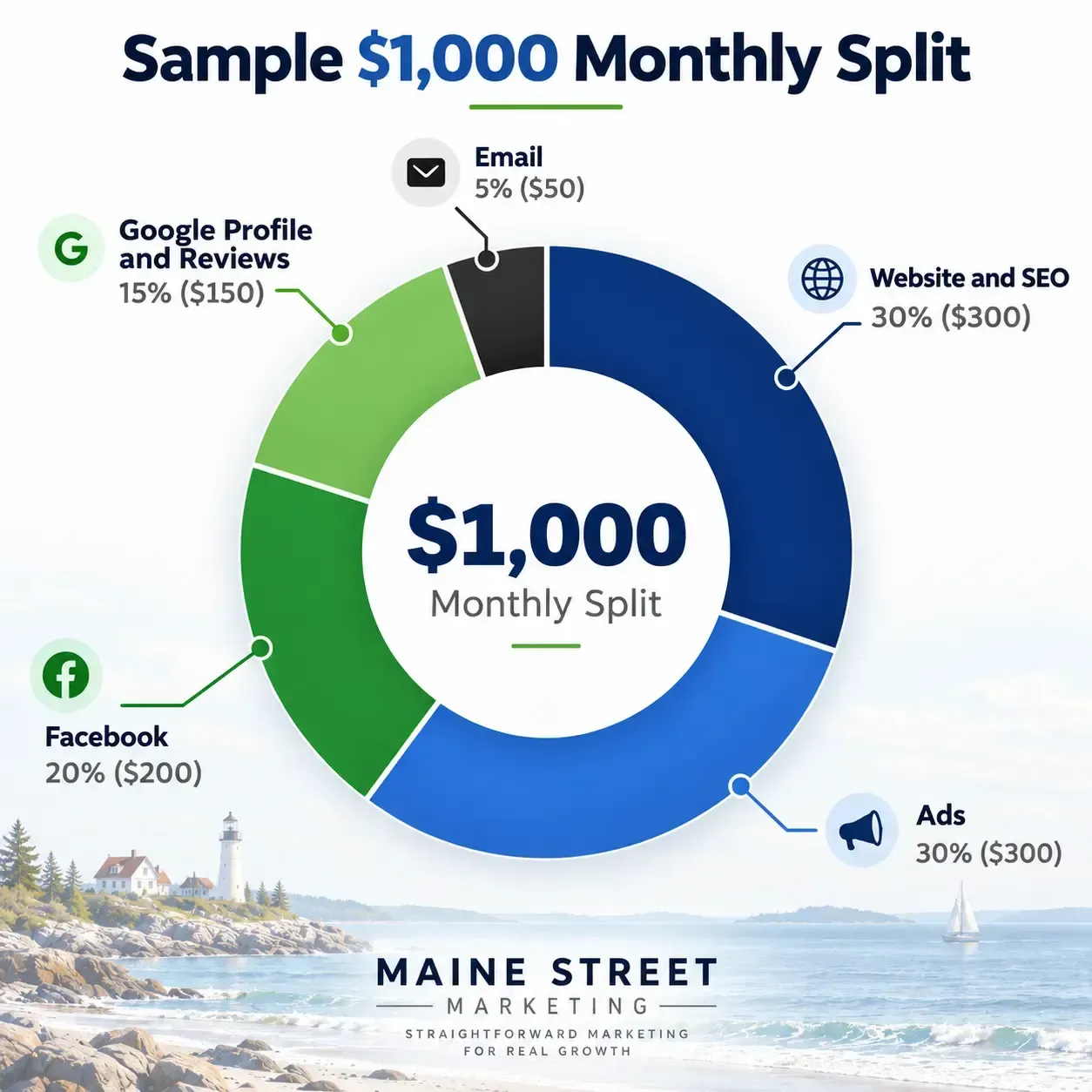
Spread thin across six channels, a small budget does very little. Spend it on two or three things that work together, and it adds up. Here's a sample split for a business spending $1,000 a month. It's a starting point, not a formula, so adjust it for your trade and your town.
Notice that ads are not first. If your website is slow or your Google profile is out of date, ads just send more people to a weak first impression. Fix those two things, then turn on ads. At a higher budget, the same order applies: build the foundation first, then grow. In the LocaliQ survey, 56% of owners used social media ads and 45% used search ads, and the owners who get the most out of either already have the basics sorted.
| Where it goes | Share | Per month | What it does |
|---|---|---|---|
| Website upkeep and local SEO | 30% | $300 | Keeps your site fast, current and showing up in local searches |
| Paid ads (Google or Facebook) | 30% | $300 | Fast leads once the basics are in place |
| Facebook content | 20% | $200 | Regular posts that keep you in front of past and future customers |
| Google Business Profile and reviews | 15% | $150 | Fresh photos, posts, review requests and replies |
| Email to past customers | 5% | $50 | The cheapest way to bring people back |
| Total | 100% | $1,000 |
A starting point, not a formula. Adjust it for your trade and your town.
How to set your number in six steps
- Start with what you want, not what you can spare. Write down how many new customers or jobs you want next year.
- Work backward. If you want 10 new customers a month and you close one in four leads, you need about 40 leads a month. That tells you how much marketing you actually need.
- Apply a percentage as a sanity check. Multiply last year's gross revenue by 7% to 8%. If your plan costs far less or far more, ask why.
- Subtract the fixed costs. Website hosting, your email tool, and listing fees come first. What's left is your flexible budget.
- Choose two or three channels. Pick the ones closest to where your customers actually look: Google, Facebook, or a referral program. Add more later.
- Set a 90-day check-in. Track phone calls, form submissions, and direction requests. If a channel isn't producing after a fair test, move the money.
Common questions
Is the 7 to 8 percent based on revenue or profit?
Gross revenue, the total you bring in before expenses.
Does my own time count?
Count what you pay out of pocket, plus the cost of any staff time spent on marketing. If you do it yourself, track the hours. They're worth something, even if they aren't a line on the budget.
Should I cut marketing if the economy feels shaky?
Many owners feel that way: 66% in the LocaliQ survey called economic uncertainty a challenge. Rather than going to zero, shift money toward things you can measure and toward past customers, who cost the least to win back.
How long until I see results?
Ads can produce calls within days or weeks. Local SEO, reviews and a stronger Google profile build over months, which is why a steady budget works better than a burst.
Not sure where your money should go?
We help small businesses across York and Cumberland Counties build a marketing plan that fits their budget. Start with a free website grade, or tell us about your business and we'll suggest where to begin.
Maine Street Marketing, 110 Main St., Suite 1001, Saco, ME 04072. Call 207-229-8159 or 207-807-1485, or email howcanwehelp@mainestreetmarketing.com.
Sources: Hartford Business, Chron and LocaliQ's small business survey.